


Can Making Minimum Payments Affect Credit Score?
What is Minimum Due?
The minimum due on a credit card is the smallest amount that a cardholder is required to pay by the due date set by their credit card issuer to keep their credit card account in good standing. This amount is typically a percentage of the total outstanding credit card bill, commonly ranging from 5% to 10%.

Credit cards are also a form of credit, and it is important to clear your credit card bills on time to maintain your credit score. At times, many users believe that paying only the ‘Minimum Amount Due’ of the credit card bill is enough to maintain the credit score. However, this is not true. Though paying the minimum amount due helps you avoid late fees, it will still affect your credit score negatively.
What is the ‘Minimum Amount Due’ on credit card?
The ‘Minimum Amount Due’ is basically a portion of your credit card bill, which you need to clear before the due date to avoid late fees or any other penalty. However, paying only the minimum amount does not completely clear your credit card bill and has a negative effect on your credit score.
How is ‘Minimum Amount Due’ Calculated?
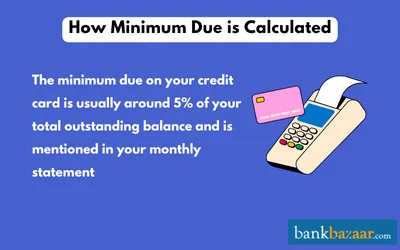
The ‘Minimum Amount Due’ is generally the 5% of your total outstanding credit card bill. Do note that this percentage varies from bank to bank, and you will have to check with your credit card issuing bank to know the minimum amount.
You will also have to add your monthly EMI amount if you have converted any purchases into EMI. Along with this, if your previous month’s minimum amount was not fully paid, the remaining part is added to the current minimum amount due.
Disadvantages of paying only ‘Minimum Amount Due’:
Some of the disadvantages of paying only minimum due amount are as follows:
- Attracts High Interest: Paying only a minimum due amount will help you avoid late fees but will attract a high rate of interest in the long run. The outstanding balance of your credit card bill will attract interest every single day, and you may end up paying much more than the actual amount.
- Outstanding Balance Increase: When you don’t clear your credit card bill completely in a particular month, it will get carried forward in the next month. So, the debt will pile up next month.
- Long Term Debt: Once the debt starts piling up, it can take months to years to clear it off. Since most of your payment is going towards fees and interest payments, the actual principal amount hardly gets reduced.
- Credit Score Drops: Many credit card users believe that paying minimum due amount will not have any negative effect on credit score. But doing so increases your credit utilisation ratio, which in turn lowers your credit score.
- Reduced Available Credit: When you consistently pay only the minimum amount due, the banks block your available credit limit. This will make it harder for you to use your credit card for big purchases.
Report from Issuers
The revolving accounts and most recent credit report of a customer contain fields such as rating, amount due, past due, amount paid and balance. The rating and balance are the most important factors of a customer's credit score as they contribute towards their repayment history and credit utilisation rate that is how much of the credit limit is used, respectively.
The details about amount due and amount paid will indicate that the customer has paid their whole balance within the time frame. However, the number of issuers who report the aforementioned data currently stands at only 70% of the total.
What Happens When a Customer Makes Minimum Payments?
It is instrumental for your credit score to make payments on time. Even if the customer can only afford to make the minimum payment in any given month, it is essential to do so on a consistent basis so that your credit rating is not adversely affected.
Conversely, customers who make minimum payments but miss out now and again will have to deal with a decrease in their credit score. Problems with credit scores may also occur if a customer makes minimum payments and at the same time, spends and increases his credit card balances.
In this case, the credit utilisation rate is affected, which then affects his credit score. FICO advises all customers to ensure that their credit utilisation rate is under 30%. Basically, what matters more that the amount paid every month is the consistency with which the customer makes payments.
Since an increasing number of people are making minimum payments, the behavioural pattern among credit card users has changed. A survey found that customers who make full payments were 63% less likely to default in a period of six months, while customers who make minimum payments or pay just above the minimum amount were 86% more likely to default in the following six months.
CIBIL Related Articles
- Tips for good CIBIL Score
- Mistakes That can negatively impact your CIBIL Score
- CIBIL
- CIBIL Redressal Process
- CIBIL Score -1
- Good Mix of Credit Can Boost Your CIBIL Score
- What is Considered as a Bad Credit Score
Disclaimer
Display of any trademarks, tradenames, logos and other subject matters of intellectual property belong to their respective intellectual property owners. Display of such IP along with the related product information does not imply BankBazaar's partnership with the owner of the Intellectual Property or issuer/manufacturer of such products.


FAQs on Minimum Payments Affect Credit Score
1.Will my credit score increase if the credit card is not used?
No, the credit score will not increase or decrease if the credit card is not used.
2.Will my credit score fall if only the minimum amount is paid every month?
Yes, the credit score will fall if only the minimum amount is paid every month as the credit utilisation ratio will increase.
3.Will a penalty be levied in case a payment less than the minimum amount due is made?
Yes, a penalty will be levied in case a payment less than the minimum amount due is made.
4.Is it better to pay the full credit card bill or the minimum due amount?
It is advisable to pay the credit card bill to avoid accruing interest on the remaining balance and any subsequent purchases. However, in times of financial constraint, you may opt to pay the minimum balance.
5.What happens when I pay only the ‘Minimum Due Amount’?
Paying the minimum due amount on your credit card bill prevents you from incurring late fees. However, the remaining balance will accrue interest until it is paid in full, affecting any future purchases made on the card.
6.How can I pay more than the minimum amount?
To pay more than the minimum amount, consider limiting credit card usage, particularly during financial challenges. Prioritize cash payments over credit to avoid accumulating additional debt.
7.Why did my credit score decrease despite paying the minimum balance?
Consistently paying only the minimum balance may negatively impact your credit utilization ratio over time, leading to a decrease in your credit score.
8.Does doubling your credit score mean better credit?
However, for a different reason, paying twice a month can actually raise your credit score. Using this technique can appear to lessen your credit utilisation ratio, which eventually raises your credit score.
9.What is the rule of credit 15/3?
The practice of making your monthly payment in two installments—the first half 15 days before your due date and the second half three days before your due date—gives rise to the moniker of the 15/3 credit hack. This trick, which is widely used on social media, says it may get you from bad credit to good credit faster.
10.Is using a credit card once a month okay?
Once your debt is paid off and you understand how to stay out of debt, you can use your cards more frequently. Using credit cards in place of cash and utilising rewards programmes like cash back or frequent flyer miles are perfectly acceptable as long as the entire debt is paid off each month on time.
CIBIL Score Requirements for Loans

Disclaimer
Credit Card:
Credit Score:
Personal Loan:
Home Loan:
Fixed Deposit:


Copyright © 2026 BankBazaar.com.