


Top 10 Highest Currencies in the World in 2026
The currency having the greatest purchasing power in relation to all others is referred to as the strongest currency in the world. To put it simply, a stronger currency can buy more than a weaker one. However, economic importance is not necessarily reflected in exchange rate strength; smaller economies with less global influence are among the top currencies in the world rankings.

List of Highest Currencies in the World 2026
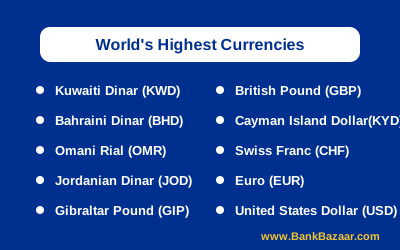
The highest currencies in the world in 2026 are mentioned in the table below:
As of February, 2026
Currency | INR Value (₹) | Value in USD ($) |
Kuwaiti Dinar (KWD) | 299.25 | 3.27 |
Bahraini Dinar (BHD) | 243.13 | 2.66 |
Omani Rial (OMR) | 238.23 | 2.60 |
Jordanian Dinar (JOD) | 129.65 | 1.42 |
British Pound (GBP) | 125.53 | 1.37 |
Gibraltar Pound (GIP) | 124.82 | 1.36 |
Swiss Franc (CHF) | 119.11 | 1.30 |
Cayman Islands Dollar (KYD) | 109.49 | 1.20 |
Euro (EUR) | 108.69 | 1.19 |
United States Dollar (USD) | 91.54 | 1.00 |
Kuwaiti Dinar (KWD)
1 KWD = ₹299.25
The Kuwaiti Dinar is now the world's strongest currency, known for having the highest nominal value. The primary reason for this strength is Kuwait is oil industry, which plays a significant role in driving the economy.
With a comparatively small population and one of the largest oil reserves in the world, Kuwait has a higher per capita income, which contributes to the dinar's strength.
Bahraini Dinar (BHD)
1 BHD = ₹243.13
The Bahraini Dinar's strong banking industry and oil exports make it one of the world's strongest currencies. In terms of nominal value, it is the second-strongest currency.
The Bahraini Dinar is the second-strongest currency in the world due to Bahrain's strategic positioning as a financial center in the Gulf, which has drawn substantial foreign investment.
Omani Rial (OMR)
1 OMR = ₹238.23
Oman's significant oil exports and responsible financial policies support the Omani Rial. It is the world's third-strongest currency. Oman's economy still depends heavily on oil, although the government has made great progress in broadening its sources of income. Oman's official currency is the Omani Rial or OMR. INR was the official currency of Oman until 1940. For this reason, the INR to OMR rate is the most often used Rial exchange rate.
Jordanian Dinar (JOD)
1 JOD = ₹129.65
Jordanian dinar (JOD), Jordan’s official currency, and the Israeli shekel were used by the West Bank. One of the primary reasons for the high value of this currency is its fixed exchange rates. The JOD to EUR rate is the most widely used Jordan Dinar exchange rate. The economy of Jordan is diversified in various sectors as it does not majorly depend on oil exports. It is located where Asia, Europe, and Africa converge. Due to its strategic location, Jordan attracts foreign aid and investment as a hub for trade and transportation.
Gibraltar Pound (GIP)
1 GIP = ₹124.82
Pegged to the British Pound. The Gibraltar Pound is exchanged at par (1:1) with the British Pound Sterling. While the Government of Gibraltar prints its own notes, the currency's value mirrors the UK's economic performance.
British Pound (GBP)
1 GBP = ₹125.53
The British Pound, one of the world's oldest currencies, remains strong in the global money ranking due to the United Kingdom's diverse and advanced economy, and it is consistently ranked as one of the world's strongest currencies.
London, one of the biggest and most powerful financial centers in the UK, is essential to preserve the value of the pound.
Swiss Franc (CHF)
1 CHF = ₹119.11
The official currency of Switzerland and Liechtenstein is the Swiss Franc. The EUR to CHF rate is the most widely used Switzerland Franc exchange rate. When the country entered the currency union, it pegged the Franc to the Euro, deciding on a dual system instead of abolishing the Franc. It is unquestionably one of the most valuable currencies in the world. Switzerland's economy is known for its high GDP per capita, low unemployment, and low inflation, all of which support the franc's stability.
Cayman Islands Dollar (KYD)
1 KYD = ₹109.49
The Cayman Islands is a major offshore financial hub, which contributes to the strength of the dollar. Numerous banks and hedge funds are drawn to the region by its advantageous tax laws, which contributes to the KYD's continued high value relative to other currencies.
Euro (EUR)
1 EUR = ₹108.69
One of the biggest currencies in the world and a key component of the global currency ranking, the Euro is utilized by 20 member states of the European Union. The value of the Euro is supported by the economic might of the Eurozone, which is made up of major countries like France and Germany.
Its strength is further fueled by its widespread acceptance and use in international trade
United States Dollar (USD)
1 USD = ₹91.54
The Global Standard. The US Dollar is the world's primary reserve currency and the most traded globally. Backed by the economic and political power of the United States, it serves as the benchmark against which nearly all other currencies are measured.
FAQs on Top 10 Highest Currency in the World
- Which currency has the highest value in the world?
Kuwaiti Dinar (KWD) is the world's most valuable currency.
- Which currency is the most stable in the world?
The Swiss Franc (CHF), the currency of Switzerland and Liechtenstein, is the most stable currency in the world.
- What factors cause a country's currency to have the highest value in the world?
There are numerous elements that influence the value of a currency such as economic growth, inflation, interest rates, etc.
- Which currencies are the most commonly traded?
Major crosses like EUR/USD, USD/JPY, and GBP/USD are among the most widely traded currency pairs because they all represent developed economies with substantial wealth.
- Why is the Kuwaiti dinar so high?
The Kuwaiti currency's strength can be linked to its involvement in the oil and gas industry. Kuwait is one of the world's greatest oil exporters, with vast reserves spread across the country.
- Which are the seven major currency pairs?
Approximately 75% of all forex trades conducted globally involve the seven most popular currency pairs. These include USD/CAD, GBP/EUR, AUD/USD, and EUR/USD.
- What effects does a high-value currency have on the economy, if any?
Both are possible. A weaker currency may be advantageous for certain nations, while a high value is advantageous for others. This is because their export industry benefits from the weaker currency.

Disclaimer
Credit Card:
Credit Score:
Personal Loan:
Home Loan:
Fixed Deposit:


Copyright © 2026 BankBazaar.com.